








- Introduction
- Choose Clear Examples for Shape Games
- Separate Flat Shapes from Solid Objects
- Match a Picture to an Outline
- Sort by One Rule at a Time
- Turn a Shape and Check What Changes
- Try a Short Shape Hunt
- Make a Picture with Drawn Shapes
- Describe a Shape Without Naming It
- Change the Difficulty Without Starting Over
- Use Shape Language in Your Family's Languages
- Notice the Reasoning and Keep a Simple Routine
- Conclusion
- FAQ
Introduction
Shape games can start with a book, a sheet of paper and a few large, lightweight objects. Choose one challenge: match an outline, compare corners, sort pictures or describe a hidden card. You do not need a purchased activity kit. Begin with two shapes your child can comfortably explore, then change the challenge when they are ready.
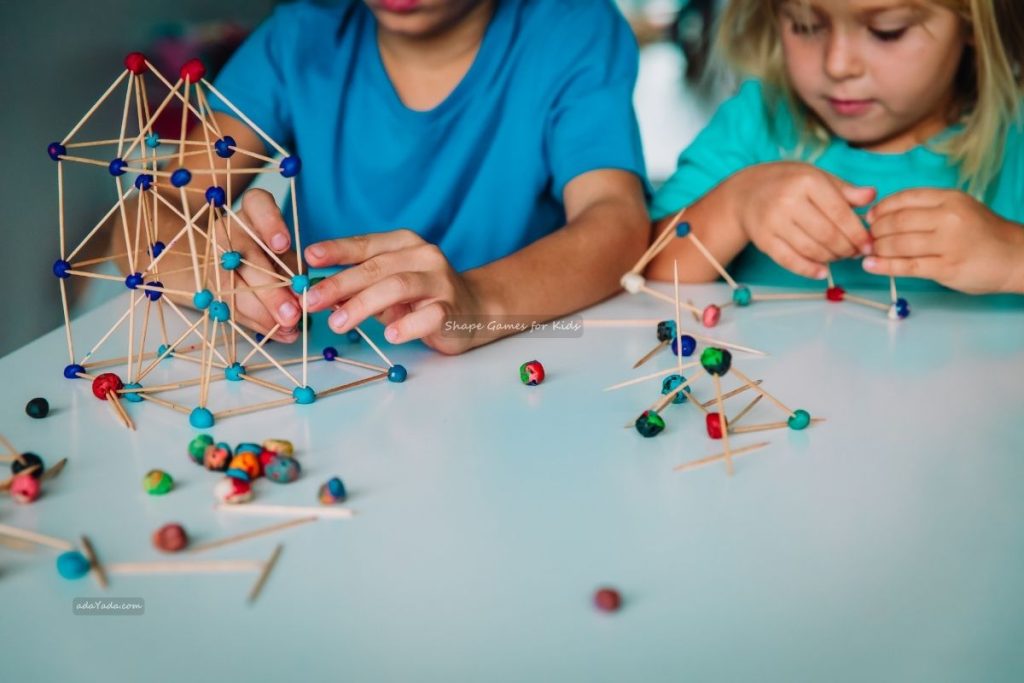
This guide offers practical shape games for families using things already at home. The activities are suggestions for shared play, not tests of development or promises of improved school performance. In a small Bangkok apartment or a larger family home, a clear tabletop can be enough space. Choose materials and a pace that suit your child.
Choose Clear Examples for Shape Games
Start with large paper drawings of a circle, square, triangle and rectangle. Draw bold outlines and leave space between them. If you want separate cards, an adult can prepare them beforehand. Keep the drawing simple: a patterned background or cartoon face may distract from the outline you want to discuss.
For these shape games, use a lightweight book to look at a rectangular cover or an unbreakable round plate to examine a circular rim. Say which part you mean. A cup is a solid object; its rim may look circular when viewed from above. Calling the whole cup a circle mixes the object with one visible outline.
- Choose large, clean materials that your child can handle comfortably.
- Use drawings when an object has unclear or rounded corners.
- Leave out glass, sharp tools, loose small parts and heavy items.
- Keep the activity supervised and the work area clear.
You can do all the shape games below with drawings if household objects are unsuitable. There is no need to use scissors as an example of a triangle or to cut food into shapes. A clearly drawn triangle is easier to discuss and avoids an unnecessary preparation task.
Separate Flat Shapes from Solid Objects
A flat drawing of a square shows four equal straight sides meeting at right angles. A cube is a solid shape with square faces. When looking at a toy block, ask about one face rather than assuming every block is a cube. Blocks come in many forms, and rounded edges can make them imperfect examples.
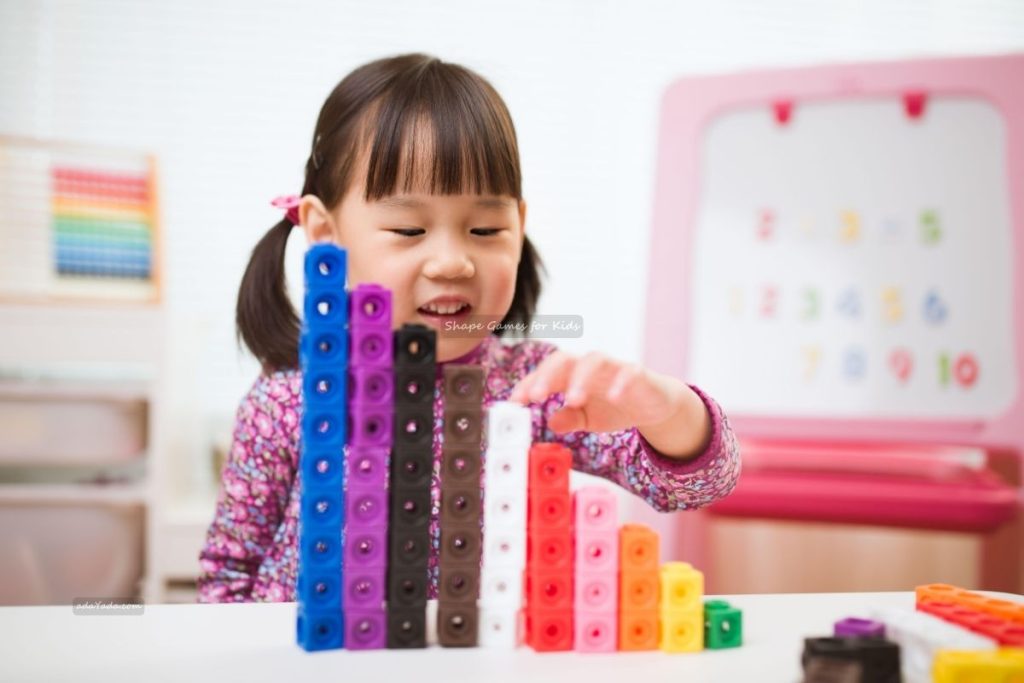
In shape games, a simple phrase can keep this distinction clear: “This face looks like our square drawing.” Turn the object and examine another face. A rectangular box may show different rectangular faces from different directions. You are comparing visible surfaces, not expecting a young child to learn every geometric name at once.
NAEYC’s Everyday Shapes resource for families discusses noticing both flat and solid shapes during ordinary routines. Use precise descriptions when they help, while keeping the conversation relaxed. If a real object is an awkward match, return to the paper examples.
Match a Picture to an Outline
Place a circle drawing and a square drawing side by side. Make a second drawing of each on another sheet. Ask your child to point to the picture that matches the circle, then swap roles. Your child can select a drawing and let you find its partner.
For the first round of these shape games, make the matching pictures similar in size. Once that feels straightforward, draw a larger circle and a smaller circle. Ask what stays the same. Both have a round boundary without straight sides or corners, even though one takes up more space on the page.
If your child chooses by color, use the same color for every drawing. If several pictures feel overwhelming, show only one pair. Pointing, moving a card or describing a match are all useful ways to take part; saying the shape name aloud does not have to be the entry requirement.
Sort by One Rule at a Time
Draw a few circles, triangles and squares. Make two sorting spaces on a sheet of paper: one for shapes with corners and one for shapes without corners. Explain the rule with one example, then invite your child to place the next picture. Keep a spare area for anything you want to discuss together.
These shape games become clearer when the sorting rule is visible. A card showing a corner can label one space, while a curved line can label the other. Ask, “Which feature helped you decide?” A circle belongs in the no-corners group; triangles and squares belong in the corners group.
Later, change the rule to three straight sides versus four straight sides. Clear the first arrangement before starting again. Explain that the pictures have not changed, but the question has. Avoid switching shape, color and size rules at the same time; it becomes harder to tell what your child is comparing.
Turn a Shape and Check What Changes
Draw a triangle on a card and place it with one point upward. Turn the card so that a different point faces up. Ask whether the outline still has three straight sides and three corners. Count them together, starting at a marked corner so you do not count the same side twice.
For another round of shape games, rotate a square. Its position changes, but the outline remains a square. Calling every tilted square a different shape can make orientation seem more important than its defining features. Instead, describe what happened: “We turned it. The sides and corners stayed the same.”
Add a narrow triangle beside a wider one. Both can be triangles, even though they do not look identical. Stanford DREME’s guide to understanding shapes explains the value of noticing defining features and different orientations. You can use that idea without turning the activity into a vocabulary quiz.
Try a Short Shape Hunt
Choose one area of the room and one target outline. For example, look for something with a rectangular face. Your child might point to a book cover or a cupboard door. Look together rather than asking them to climb, reach into storage or carry objects around the house.
In these shape games, pointing is enough. Ask which surface matches the drawing and what makes it similar. If your child chooses an object with rounded corners, acknowledge the resemblance: “It looks a bit like our rectangle, but these corners curve.” Real objects do not always match a perfect mathematical drawing.
Finish after a few discoveries and let your child choose the next target. A hunt does not need a timer, prizes or a long checklist. In a shared room, stay within a small agreed space so the activity does not interrupt other people or require a large cleanup afterward.
Make a Picture with Drawn Shapes
Invite your child to plan a simple picture using circles, triangles, squares or rectangles. They might draw a bus with a rectangular body and circular wheels, or invent an imaginary machine. Ask them to point out the shapes they chose. The drawing does not need to look realistic.
Picture-making shape games offer an opportunity to explain choices. You might ask, “Where could this long rectangle go?” or “Which part will you add next?” Avoid correcting every uneven line. If the discussion needs a precise outline, use a separate reference card rather than redrawing your child’s picture.
To add a comparison challenge, draw two different pictures using the same collection of shapes. A circle and two rectangles might become a person in one drawing and a sign in another. Discuss how the arrangement changed. The number of pieces can stay the same while their positions tell a different story.
Describe a Shape Without Naming It
Place three familiar shape cards on the table. Choose one silently and give a clue, such as “My shape has three straight sides.” Let your child point to the triangle, then explain which detail matched. Switch roles so they can choose a card and give you a clue.
These shape games work best when the clues separate the available choices. “It has corners” is not enough to choose between a triangle and a square. Ask for another clue instead of treating the first answer as wrong. Your child can add a number, trace a side or gesture toward a feature.
Be careful with squares and rectangles. A square is a special kind of rectangle, so “four right angles” can describe both. For an introductory guessing game, you can use a circle, triangle and square. Introduce overlapping categories later, when your child wants to compare those details more closely.
Change the Difficulty Without Starting Over
You can reuse the same cards across several shape games. For an easier version, offer two choices, keep the drawings upright and let your child place matching pictures together. For a harder version, add a rotated drawing or a second example in a different size.
For shape games, change only one feature at a time. If you introduce new shapes, unfamiliar words and a memory challenge together, a confused response will not tell you which part was difficult. Return to the simplest version and notice where your child can participate comfortably.
For siblings, give different roles within the same activity. One child might locate a matching card while another describes its sides. Then swap who chooses the next picture. There is no need to race or make both children answer the same questions. Shared play can include different levels of explanation.
Use Shape Language in Your Family’s Languages
Shape games can fit a household that uses Thai, English, Swedish or another language. Keep the drawing visible while speaking in the language that makes the discussion easiest. A child can show understanding by pointing or sorting even when a particular word is unfamiliar.
If adults use different languages, agree which feature you are discussing. Both can point to the same corner or trace the same side. Introduce an additional label when it is useful, rather than asking for a translation after every answer. This article does not supply translations or pronunciation guidance.
Keep a small reference sheet with the pictures your family uses. Add labels only when you are confident they are accurate. During shape games, the immediate aim can be describing what you see together; it does not have to become a simultaneous lesson in reading, spelling and a second language.
Notice the Reasoning and Keep a Simple Routine
During shape games, listen for the feature behind an answer. If your child calls a triangle a square, ask them to show the sides with a finger. You can count together and compare it with the square card. This gives you something concrete to discuss instead of repeating a label more loudly.
Keep shape games brief enough that stopping feels easy. One round after putting away a book may be plenty. Store the drawings in a folder and reuse them. You do not need to photograph every attempt, award scores or create a new set of materials each day.
A useful observation might be “matched two rotated triangles today” rather than “knows all shapes.” This is a note about one activity, not an assessment. Children may respond differently when tired, distracted or interested in something else. Offer another opportunity on a different day without making comparison with other children the goal.
For a change of pace, explore our indoor play ideas for rainy days. Families arranging materials for independent choices may also find ideas in our article on Montessori methods at home. Choose activities that fit your household rather than trying to complete every suggestion.
Conclusion
Start shape games with a few clear drawings and one question your child can explore. Match an outline, sort by a visible feature or describe a card together. Use household objects thoughtfully, naming the face or outline you mean. Reuse familiar materials, adjust the challenge gradually and finish while the activity still feels comfortable.
FAQ
What do I need for simple shape games?
For shape games, paper, a pencil and a clear place to sit are enough. Large drawings can replace objects entirely. If you include household items, choose lightweight, unbreakable examples with features you can discuss clearly. An adult can prepare any cut-out cards before the activity.
Should I teach every shape in one session?
No. Begin with two familiar outlines and add another when the comparison becomes comfortable. Shape games can focus on matching before naming. A small set makes it easier to notice which feature your child is using and adjust the next question.
Is a cup a circle?
A cup is a solid object, while a circle is flat. The rim of a round cup can show a circular outline when viewed from above. Say “the rim looks circular” rather than describing the whole object as a circle.
What if my child sorts by color instead?
Use drawings in one color or acknowledge that they found another valid sorting rule. Then explain the rule for this round and demonstrate a pair. Shape games are easier to follow when only one feature changes at a time.
Do these activities need worksheets or a screen?
No. You can draw your own cards, point to an outline in a book or discuss a visible surface in the room. Keep the setup small enough to repeat. A familiar activity with a new question can be more practical than preparing new materials every time.